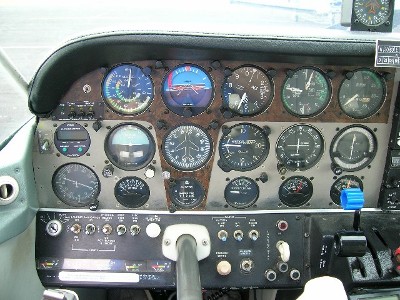
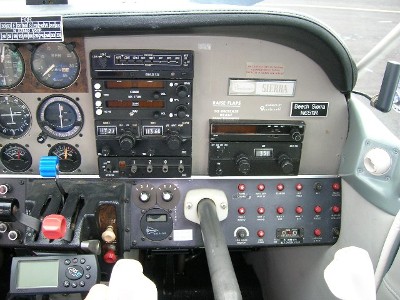
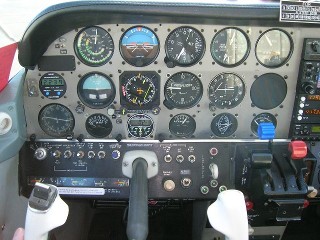
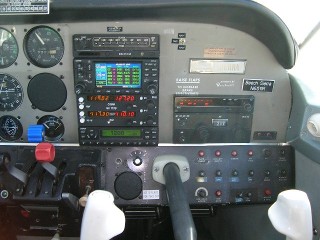
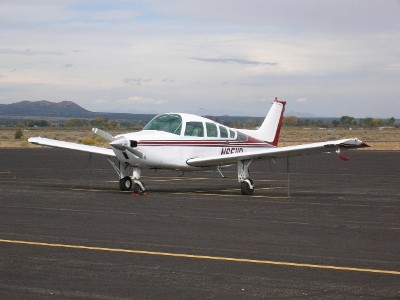
I bought this Beechcraft Sierra B24R from a father-son partnership in Arkansas. She was in good shape with fairly new paint and interior. The engine had a bit over 340 hours. A look at the logs indicated that she's had several owners including at least one flight school. The deal was sealed via emails and by phone. I got a thorough Sierra check-out by a CFI in Ohio in his airplane, then traveled to Arkansas to fly her to her new home in October, 2006.
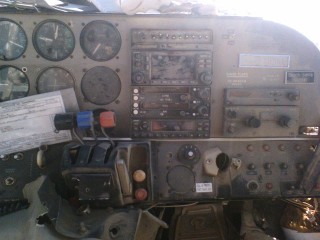
After over 30 years of flying military and airline hardware, I'd been kinda spoiled. I had to have an HSI and wanted an IFR GPS to replace the old Garmin III VFR GPS. I arranged for Flight Trails Helicopters in Mesa, Arizona to do the avionics upgrade.
HSI - Century slaved NSD-360A (the old course indicator #2 was removed)
Fuel Flow Indicator - Electronics International FP-5L (below the HSI - talks to the GPS!)
GPS & Comm-Nav #1 - Garmin GNS-430 connected to the HSI
Comm-Nav #2 - Michel MX-170B connected to the remaining Course Indicator
Transponder - Garmin GTX-327 (talks to the GPS!)
DME was updated to be remotely tuned by either Nav 1 in the GPS or Nav 2 in the Michel
The KR-85 ADF/boat anchor still works, so I elected to keep it, but probably should have had it removed
Several times during the installation, I'd get a call or an email from Flight Trails regarding problems they'd encountered.
Both the pitot and static lines needed repair. While doing that, they discovered a leak in one of the landing gear
The old King transponder wasn't transmitting, hence the new Garmin transponder
The Comm antennas needed replacing
While doing the antenna work, they discovered rotten cabin vent hoses
While running the wiring for the Fuel Flow indicator, they noticed holes in the exhaust system
The factory fuel indicators were giving bizarre readings. That was corrected and gave an excuse to add the Fuel Flow Indicator system (which has consistently been off less than 1/2%)
While these problems resulted in cost overruns, but gave me a better, more reliable airplane. Additionally, my annual inspection a few months latter went smoothly with no new-found discrepancy other than worn brakes. I am very happy with the work done at Flight Trails.
I have found the Sierra to be a pleasure to fly -- especially after getting all this work done. I even had occasion to fly a couple of real-IFR GPS approaches on the west coast.
This month (June, 2007) I took a trip with my bride of 34 years. We flew from Cedar City, Utah to the Seattle area to visit some grandkids. We continued to the San Francisco area where my wife attended a week-long conference.
On 17 June, 2007, we headed home to Cedar City. We made a fuel/potty-break stop in Tonopah, Nevada. I filed a VFR flight plan from Tonopah, Nevada to Cedar City, Utah via DUATS but had not yet activated it.
The aircraft was loaded 3 pounds under the maximum gross weight. Preflight checks showed the engine, propeller, magnetos and flight controls to be operating normally. Doors were verified as closed. Trim was set in the white band marked on the trim indicator. I selected one notch (15 degrees) of flaps for the takeoff.
The ASOS reported gusting winds to be from the northwest and a temperature of 21 degrees, That gives a very high density altitude of about 8,400 feet. Normally-aspirated engines are dogs under such conditions.
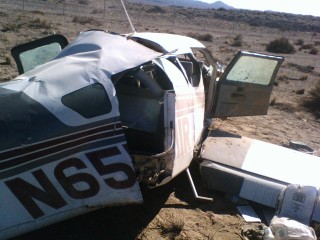
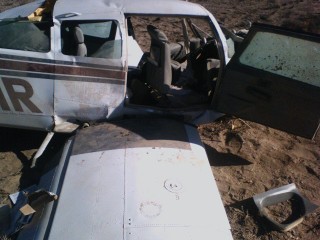
At approximately 2100 UTC (1400 PDT) I took off on runway 33 at the Tonopah, Nevada airport. I rotated at 80 knots. Throughout the short flight, the engine was producing full power. No abnormalities were apparent until I was about 30 feet above the ground and climbing at about 100 mph. At that point, I was at least half-way down the runway and initiated retraction of the landing gear. The landing gear retracted at slightly different rates which caused momentary but noticeable yaw (typical for this aircraft). Simultaneously with the landing-gear-caused yaw, the left (pilot's) door popped open about 3-4" and I felt a
slight increase in drag. The aircraft simultaneously began an uncontrollable
slow roll the right and slowly pitched down. On impact, I estimate that the
aircraft was in a right bank about 20-30 degrees and had pitched down about 10-20 degrees. I tried to correct the un-commanded roll and pitch, but the aircraft struck the ground
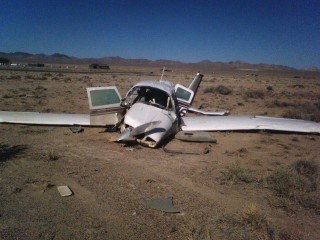
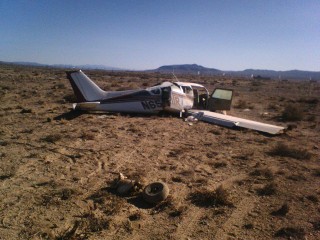
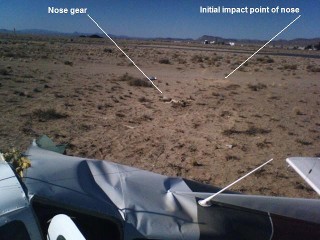
approximately 100-200 feet right of the runway and approximately even with the runway's end. The wreckage was only about 50 feet from the initial point of impact, so the airplane and our bodies absorbed most of the kinetic energy on that first impact.
The perception I had was a single lawn-dart stop into the desert -- not a slide
or a bounce. There were no marks in the soil between the first impact point and
the aircraft's final resting place. So, it did not slide to a stop but
apparently bounced. The stall horn never sounded nor was there any other
evidence of stall such as airframe buffet. I believe that the loss of roll and
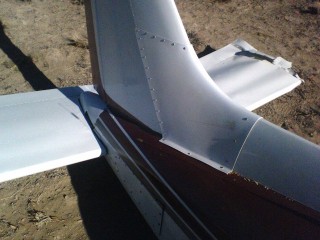
pitch control resulted from a disruption of normal airflow over the left elevator with the door ajar.
At the moment of impact, the engine was still producing full power and the flaps were still set at one notch. I was able to exit the aircraft after
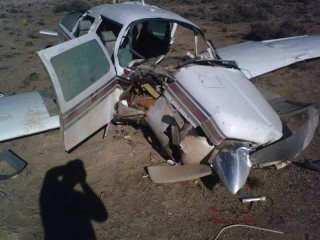
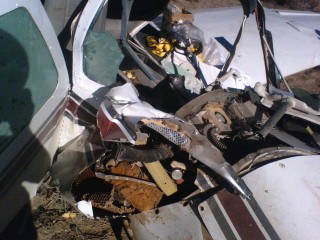
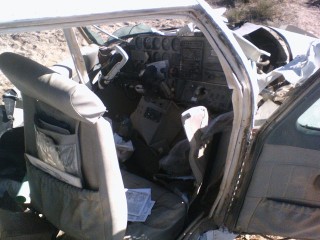
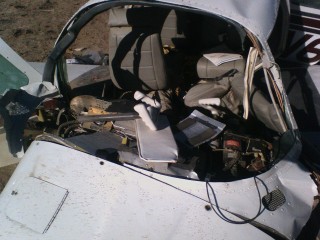
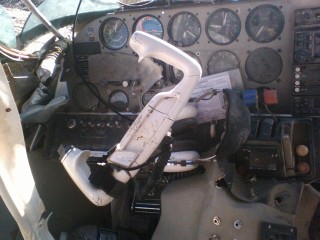
using my pocketknife to cut my seatbelt and shoulder belt. My wife was unable to exit the aircraft because the structure had crushed in a way to wedge her legs between the rudders and her seat. She had to be removed by rescue workers who dismantled part of the aircraft to free her legs. Although there was the smell of fuel fumes, there was no post-crash fire. The gusty winds dissipated the fumes before they could reach a flammable concentration.
The gentleman from whom we had just bought fuel reported to the FAA that he heard me take off and that the engine sounded normal. He assumed that we were safely on our way. As mentioned previously, I had filed a flight plan, but had not yet activated it, so the flight following process would not have begun searching for us at our estimated arrival time at Cedar City. On top of that, our Emergency Locator Transmitter did not activate on impact as it should have. Were it not for our proximity to the airport, my possession of a cell phone, our being within cell phone coverage, and the fact that I was not incapacitated, we might have sat unrescued for many hours or even a few days.
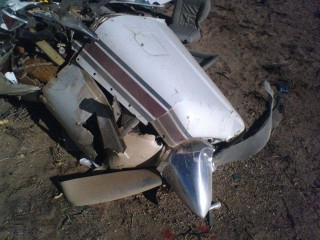
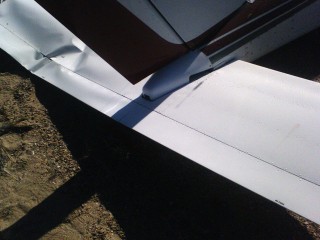
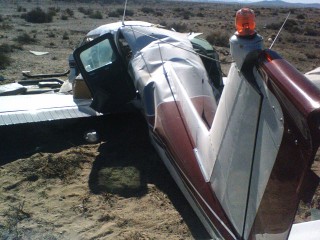
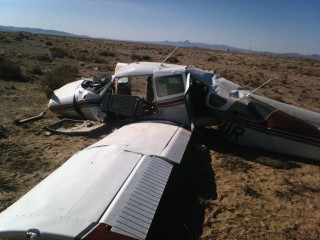
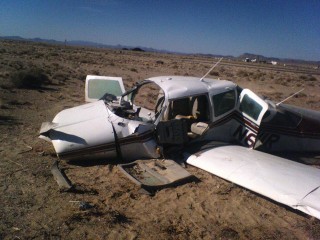
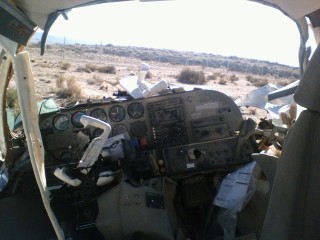
As you can see from the photos below, the airplane was destroyed.
My wife's injuries included a compound fracture of the right tibia and fibula (lower leg bones) and fractured/dislocated bones in the left foot, and a fractured sternum where the yoke hit her. My injuries were limited to bruises, a 12-stitch laceration on the left hand, a fracture in the left ankle, a dislocation in the shoulder, and my pride. We were very lucky to have survived. A couple of the people in the emergency room said that we were surrounded by angels. Of that, I am sure. But some of those angels included the members Tonopah's all-volunteer EMT team and fire department who took care of us at the crash scene and got us to the hospital. More mortal angels cared for our injuries in the Tonopah hospital and flew my wife to Las Vegas for care that Tonopah was unable to provide. After my wife's release from the hospital, still more angels (our neighbors) bought in home-cooked meals so I could focus on tending my wife.
Of course, I have gone over this accident in my mind a thousand times. All I can come up with is that I was unable to cope with a combination of factors which included high density altitude, high gross weight, wind shear, disruption of airflow over the wing and elevator due to the open door, the distraction of the open door, degraded performance due to the drag of the open door, and insufficient altitude to recover from the un-commanded pitch and roll.
The FAA/NTSB accident investigation revealed that Beechcraft Sierras were the subject of a 1990 Beechcraft "Safety Communique" concerning cabin door operation/openings. The Communique states that an open cabin door does not change an airplane's flight characteristics. However, it does state that an aircraft's climb performance can be decreased up to 130 feet per minute from handbook values, and that the decrease in climb performance can be more significant at high density altitudes. The performance section of the Pilot's Operating Handbook indicates the airplane should climb at about 300 feet per minute at the gross weight we had on that day. Subtract from that a 130 feet-per-minute penalty for an open door and the airplane can be expect to climb, at best, 170 feet per minute. That's just not much performance to deal with wind shear a few feet above the surface.
With over 20,000 hours in my logbook with nary a scratch on an airplane, I can say I'm no rookie. Nevertheless, I got into a very serious situation that I could have avoided by waiting a few hours for cooler air and for the gusty winds to die down. I could have flown with a lighter fuel load (we only need a bit more than half the 40 gallons we had on board). My wife and I could have traveled with a bit less luggage. I could have checked the security of that door one more time.
It's a hard-learned lesson about heavy-weight operations at high density altitudes with gusty winds. If everything else goes well, you'll probably get away with it. But, there is no margin for anything to go wrong. And it did. And there are no do-overs.
"Young man, was that a landing or were we shot down?" -- Elderly woman's challenge to an airline pilot
While we thank them for their support of this website, the ol' Buffalo had no role in picking the GoogleAds herein. Their appearance is not an endorsement by the Ol' Buffalo.
.jpg)
.jpg)
.jpg)
.jpg)
.jpg)